
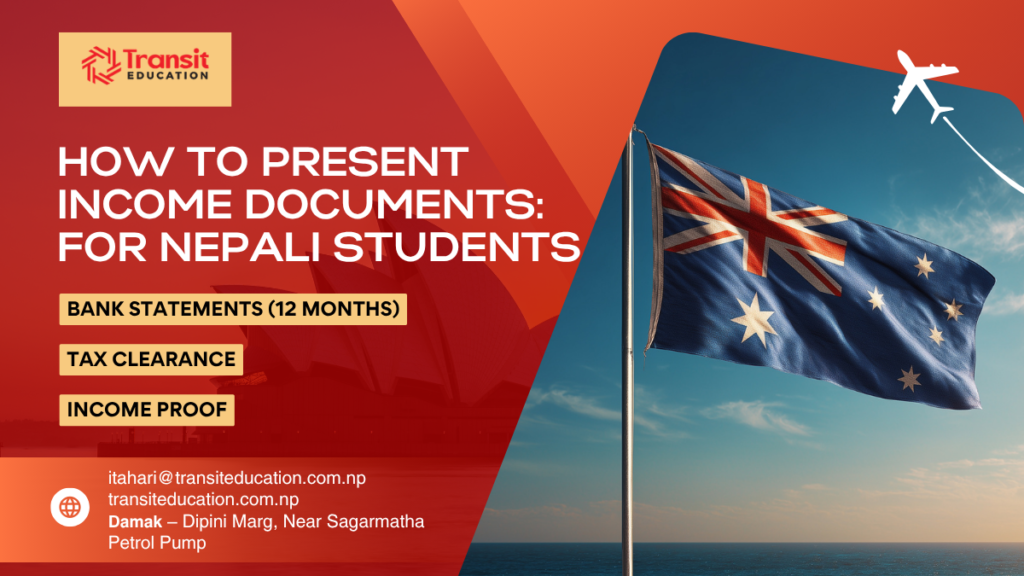
Australia remains the premier destination for Nepali students seeking world-class education and global career opportunities. Whether you are applying from the bustling streets of Kathmandu or the growing hubs of Itahari, Damak, and Damauli, the dream is the same.
However, in 2026, meeting the academic requirements is only half the battle. The most common reason for visa refusal today isn’t low grades it’s poorly presented financial documents. With Nepal now classified as an Assessment Level 3 (High Risk) country, the Department of Home Affairs is scrutinizing every rupee.
The 2026 “Genuine Student” (GS) Reality Check
To secure your visa, you must satisfy the Genuine Student (GS) requirement. This means proving you have “genuine access” to funds. In 2026, the baseline financial requirement has increased:
- Annual Living Expenses: $29,710 AUD (This is the mandatory minimum).
- Tuition Fees: Varies by university (typically $25,000–$45,000 AUD).
- Travel Costs: Approx. $2,000 AUD.
Expert Note: It is not enough to simply have this money in a bank. You must prove the source of that income over a consistent period.
The Real Problem: Late Financial Planning
Most students start thinking about their bank balance after they graduate. This creates a “financial gap” that looks suspicious to visa officers.
The Risks of Late Preparation:
- Unexplained Large Deposits: Sudden cash injections into a bank account are a “red flag” for money laundering or “show money.”
- Academic Gaps: If you spend 12 months “fixing” your finances after graduation, Australia may view you as a non-genuine student.
When should you start?
- After +2: Start preparing during Class 11.
- After Bachelor’s: Start preparing in your 3rd year of university.
The Challenge of “Informal Income” in Nepal
In Nepal, wealth is often informal. Many families earn significantly through:
- House Rents: Collected in cash or via e-Sewa/Khalti.
- Agriculture: Sales to local wholesalers without receipts.
- Small Businesses: Cash-heavy transactions with no VAT invoices.
While this income is real, it is invisible to a visa officer unless it is “Formalized.”
How to Make Informal Income Acceptable
To “ace” your GS assessment, you must convert your cash flow into a Logical Financial Story. Follow these steps:
- Bank Everything: Stop collecting rent or business income in cash. Deposit it into a single Class A Bank account on the same date every month.
- Use Digital Trails: If you receive funds via e-Sewa or Khalti, transfer them immediately to your formal bank account with a clear remark (e.g., “Monthly Shop Rent”).
- Pay Your Taxes: Take your bank statements to your local Ward Office or the Inland Revenue Department. Pay the necessary taxes and obtain a Tax Clearance Certificate.
- Consistency is King: A bank account showing 12 months of steady $1,000 deposits is 10x stronger than an account that suddenly gets $12,000 one month before the application.
Complete Financial Checklist for 2026
Ensure your folder contains these three pillars of evidence:
- Income Verification: Letters from employers or business registration documents covering at least 12 months.
- Tax Documentation: Tax clearance certificates for the last two fiscal years.
- Traceable Bank History: Statements showing the “source to bank” movement of funds.
Why Students Still Face Refusal (Level 3 Impact)
Because Nepal is Level 3, the Australian High Commission now performs manual verification. They may call your employer, visit your shop, or verify your land ownership records. If your documents don’t match the “vibe” of your lifestyle, they will refuse the visa under “Public Interest Criterion 4020” (Fraud/Misleading info), which carries a 3-year ban.
Final Thoughts: Start Your Story Today
Financial documentation for Australia is not a paperwork task it is a strategy. Students who plan ahead and formalize their family’s hard-earned income have a significantly higher success rate.
At Transit Education, we specialize in the “Financial Forensic” side of your application. From our offices in Kathmandu, Itahari, Damak, and Damauli, we help families in Koshi Province and beyond build credible, verifiable, and successful visa profiles.
Don’t leave your future to chance. Visit your nearest Transit Education branch today to start your 12-month financial roadmap.
Frequently Asked Questions
What is the minimum bank balance for an Australia Student Visa in 2026? You must show enough to cover your first year’s tuition plus $29,710 AUD for living costs and $2,000 AUD for travel.
Can I show income from agriculture for my visa? Yes, but it must be backed by a “Lalpurja” (Land Ownership Certificate), a recommendation letter from the local ward, and evidence of income deposits in a bank account.
Does Australia accept e-Sewa or Khalti statements as proof of income? No. While they show you have money, they are not considered “Official Banking Channels” for visa purposes. You must transfer those funds to a Class A bank to create a verifiable record.
How much academic gap is acceptable for Australia in 2026? Australia prefers a gap of less than 12 months. If your gap is longer, you must provide strong evidence of work experience or professional development during that time.